Who Owns Web Governance? The CISO, CPO, CAO, and CMO All Do
 July 6, 2026



Corporate websites present different challenges for these organizational leaders.
- Chief Information Security Officer (CISO): The website is a security perimeter with third-party scripts from potentially unvetted vendors and shifting data egress points.
In plain English: CISOs want nothing running on the site they didn’t sign off on. - Chief Privacy Officer (CPO): Consent requirements that vary by geography, enforced across thousands of pages, amidst constant releases.
In plain English: CPOs care about complying with privacy regulations and are on the hook when personal data gets collected without consent. - Chief Analytics Officer (CAO) & Chief Marketing Officer (CMO): The website is the primary source of campaign and conversion data. When tags misfire or tracking breaks, marketing decisions get made on bad numbers.
In plain English: The analytics and marketing leads care about data they can trust and nothing slowing them down.
Same website. Many possible definitions of broken.
What none of them get from native browser tools, tag managers, or consent management dashboards is a complete and verifiable view of what’s actually happening in production across thousands of URLs, multiple regions, every release. That’s what ObservePoint provides and how the platform shows up in security reviews, privacy audits, and campaign post-mortems.
Here’s how ObservePoint supports each leader, and why these three (or four) roles overlap more than most organizations realize.
ObservePoint for CISOs: Configure Alerts for Web Security Risks
CISOs spend most of their time on infrastructure they own: endpoints, identity, networks, cloud workloads. The website is different. It’s a piece of infrastructure where dozens of third-party vendors execute code directly on every visitor’s device.
Every marketing pixel, analytics tag, and session replay script is a vendor with access to your pages. You didn’t write the code. You may not have vetted them yet. And when that vendor loads a fourth-party dependency you’ve never heard of, your attack surface just expanded. Magecart-style attacks work by compromising a trusted script that’s already inside the house.
What ObservePoint gives a CISO:
- Vendor inventory. A map of every script, tag, and cookie executing across your pages, and what’s loading or setting them. You can’t govern what you can’t see.
- Egress monitoring. Immediate detection when a known tag starts beaconing data to a new, unauthorized domain or when a script changes behavior without notice.
- Change detection. Alerts when new scripts appear on your pages, so the marketing team adding a new pixel doesn’t become a security incident you find out about later.
- Audit evidence. When assessors ask what was running on your payment pages and when it changed, ObservePoint has the answer: scheduled scans, timestamped results, and a change history ready to hand over. It satisfies PCI DSS 4.0 Requirements 6.4.3 and 11.6.1 without a manual documentation effort.
Most security teams are trusting that the marketing stack is clean. ObservePoint lets you verify it.
ObservePoint for CPOs and DPOs: Privacy Proof that can Stand Up to Regulators & Legal Counsel
A CPO can build a rigorous privacy program with a CMP, a vendor list, a data map, regional banners, DPIAs, and still have no idea whether any of it is actually enforced on the live website at 2 a.m. on a Tuesday in São Paulo.
That disconnect between policy and production is where regulators look. It’s also where complaints originate. Honoring Global Privacy Control, respecting opt-outs under CCPA/CPRA, complying with GDPR, LGPD, DPDPA…none of this is a one-time configuration. Tags get added. CMPs get bypassed. Vendors push updates. Geographies get missed.
What ObservePoint gives a CPO:
- Consent validation. Automated audits across markets and user journeys that confirm tags only fire after consent, that opt-outs actually stop tracking, and that GPC signals are honored.
- CMP alignment. A cookie and tag inventory mapped to your CMP categories, so what’s disclosed in the banner matches what’s loading on the page.
- Geo-aware testing. Catches the “works in the US, breaks in the EU” failure mode before a regulator does.
- Defensible audit trail. Timestamped evidence of consent behavior, cookie durations, vendor calls, and data flows, ready to hand to counsel.
Privacy programs survive audits when they can produce evidence. ObservePoint makes sure you have it.
ObservePoint for CAOs and CMOs: Your Dashboards are Only as Good as Your Tags
CMOs make expensive decisions like where to spend, what to cut, and which campaigns to scale. They base their decisions on the analysis, modeling, and strategic thinking provided by the CAO and analytics teams. This requires data the business can trust. Most data quality problems are not analysis problems. They’re tracking issues.
A broken GA4 event, a duplicate tag, a misfiring conversion pixel, redirects that strip important values; any one of these can corrupt the numbers feeding marketing spend, executive reporting, and product decisions. By the time someone notices the revenue numbers “look weird,” bad data has already shaped a quarter of choices.
What ObservePoint gives marketing and analytics leaders:
- Tag and event validation. Did the right tag fire, with the right values, in the right order, on the right pages?
- Pre-release testing. Staging audits plus production monitoring after launch, so site changes don’t silently break tracking.
- Variable-level checks. Catches what humans miss: wrong values, missing parameters, duplicate events, tag latency dragging Core Web Vitals.
- Pinpoint diagnosis. When something breaks: which page, which tag, which part of the code, which vendor.
ObservePoint keeps your numbers clean and catches errors before anyone else, so you don’t have to second-guess your decisions.
Where the Three Roles Converge
Here’s what most organizations underestimate: CISOs, CPOs, CAOs, and CMOs are largely looking at the same surface. They just call it different things and grade it on different criteria.
Three places the jobs converge:
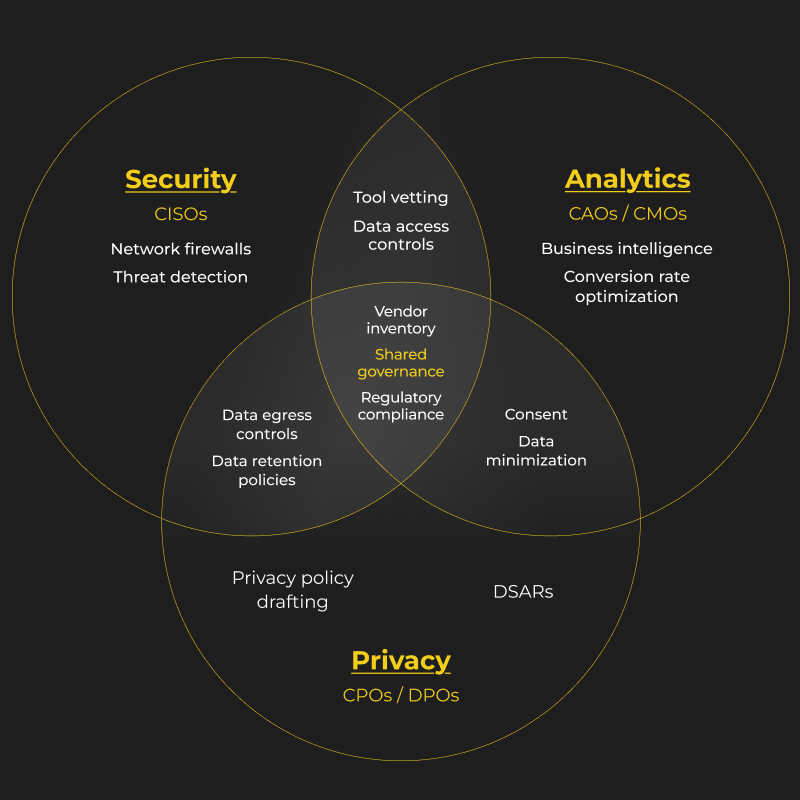
Third-party scripts. To security, they’re a potential threat. To privacy, they’re data processors with disclosure obligations. To analytics, they’re the source of measurement. All three need the same authoritative inventory and change history.
Consent enforcement. Privacy owns the policy, but security cares because unauthorized scripts firing before consent represent a control failure, and analytics cares because broken consent handoff creates holes in attribution data. A misconfigured CMP is everyone’s problem simultaneously.
Vendor governance. Every new MarTech tool needs a security review, a privacy review, and an analytics decision at the same time. With a shared system of record, each function can be aware from the get go.
ObservePoint offers a single platform that provides visibility across these roles, providing the same evidence. When the CISO, CPO, and CAO all reference the same tag inventory, the same change log, and the same consent test results, governance moves faster and the perpetual “marketing added a tag without telling anyone” cycle starts to break.
One source of truth. Three lenses on it.
Common Questions
Is ObservePoint a security tool? Partly. Traditional security tools watch your infrastructure: your servers, your network, your endpoints. They don’t watch the dozens of third-party scripts running in your visitors’ browsers. ObservePoint does. It complements your existing stack; it doesn’t replace it.
Is ObservePoint a privacy tool? ObservePoint isn’t a CMP. It’s the system that verifies your CMP, vendor list, and consent claims actually hold up in production across geographies, releases, and user journeys. It produces the evidence you need for regulatory compliance.
Is ObservePoint an analytics tool? It doesn’t replace your analytics platform. It validates that the data flowing into GA4, Adobe Analytics, your CDP, and your marketing pixels is correct, complete, and consented, so the analyses built on top are trustworthy.
Who typically owns ObservePoint internally? Usually one team operates the platform, Analytics, MarTech, or a dedicated Digital Governance group, while Security and Privacy consume reports and alerts as stakeholders. The shared-evidence model is what makes cross-functional governance practical without requiring cross-functional meetings for every decision.
Get the Same View Your Peers Already Have
Whether you’re a CISO worried about the next breach, a CPO trying to prove enforcement across a complicated multi-jurisdiction privacy program, or a CAO tired of explaining why last week’s numbers shifted, the underlying problem is the same. Your website is a complex, third-party-dependent system that nobody has regular, defensible visibility into.
ObservePoint gives all three of you that visibility, in the format your role actually needs.
Request a demo and bring the other two roles. The conversation gets a lot shorter when everyone is looking at the same data.