The 2025 Website Trends and Predictions You Need to Know
 March 25, 2025
 40 mins




Summary
With global ad spend surpassing $1 trillion for the first time and third-party cookies here to stay, 2025 is shaping up to be a year where the gap between efficient and inefficient digital operations becomes very expensive. This session brings together Ethan Prete, Dave Smith, and Mike Fong from ObservePoint to break down three trends every website owner needs to understand:
- The rising cost of ad spend — and where budgets are silently leaking
- The future of third-party cookies after Google’s deprecation reversal
- The European Accessibility Act deadline and what it means for your website
Watch this session to see the new ObservePoint features built around each of these trends, including email link validation, cross-domain cookie reporting, and accessibility issue reporting — all launching in 2025.
Key Takeaways
-
Up to 8–9% of ad spend is being wasted on broken or misconfigured landing pages — and most organizations don't know it.From paid search ads resolving to 404 pages to email campaigns driving traffic to pages missing analytics or consent managers, the leakage is silent and compounding; automating link validation before campaigns go live is the most direct way to claw it back.
-
Third-party cookies aren't going away — which means ongoing visibility into your cookie estate is now a permanent requirement.After Google reversed its deprecation plan in July 2024, organizations that deprioritized cookie monitoring need to re-engage, with cross-domain reporting becoming essential for answering legal, compliance, and governance questions at scale.
-
The European Accessibility Act takes effect June 28, 2025, and applies immediately to new and significantly updated digital properties.With WCAG compliance as the measurement standard and enforcement expected to ramp up in early 2026, organizations building new websites or making major CMS updates right now are already in scope.
-
The key differentiator in 2025 will be how effectively organizations automate the detection and remediation of website governance issues.With ad costs up 11% year-over-year and regulatory risk increasing across privacy and accessibility, the organizations that win are those with automated monitoring that turns invisible problems into actionable alerts before they become expensive ones.
Webinar Transcript
We'll give a minute or two for everyone to filter in. As people are joining, I'd love to hear where everyone's joining from — drop it in the chat or Q&A. I'll set the example: I'm joining from Pleasant Grove, Utah, otherwise known as ObservePoint headquarters. For those who don't know me, my name is Ethan Prete and I run marketing here at ObservePoint. Today we're joined by Dave Smith, CTO, and Mike Fong, Solutions Engineer, who is staying up late to join us from England. Today we're talking through the predictions and trends we've been tracking — and since we're already a few months into the year, we've actually started to see how things are unfolding rather than just guessing. We are live, so please use the Q&A function for any questions. Let's make this collaborative.
The first topic is ad spend, which is getting absurdly expensive. Global ad spend is projected to surpass $1 trillion for the first time ever this year. 50% of brands are planning to boost influencer marketing — an expensive channel — which shows how competitive things are getting. And year-over-year, we're anticipating 11% growth in global ad spend, meaning whatever you spent last year, it's going to cost more to compete this year. Mike, you're boots on the ground with our customers — what are you seeing?
Digital marketing has been growing year-on-year since it came into existence, but what happened during COVID was that the whole world went digital overnight — no conferences, no leaflet drops — and a huge amount of marketing spend was redirected to digital channels. Just like housing in San Francisco or Central London, you inflate the cost of limited assets through demand, and those costs haven't come back down. What we're seeing with customers is a real push to find efficiency gains to counteract higher CPCs. One large U.S. retailer spending over $100 million on ads estimated that 8–9% of their spend was being wasted — primarily on ads driving traffic to 404 error pages. This is surprisingly common: typos, campaigns not turned off after a seasonal promotion, links that simply weren't checked. We helped that organization detect and prevent that loss. Suddenly an 11% year-over-year cost increase becomes a much more manageable 2% net increase. We've also worked with a university that had nearly half a dozen ads resolving to 404 pages — they saved tens of thousands of dollars in the first year alone, with those savings compounding over time. If you're not aware you're losing that percentage yet, please do check — it could be very easy, low-hanging fruit.
The prediction I'd give coming off Adobe Summit is that every company has a marketing funnel they're trying to optimize, and the ones that will be effective in 2025 are those that can find the leakage and prevent it. Your ROI on any marketing function is going to be lower in 2025 than 2024 if you're just spending more. The key differentiator is how effective you are at automating the detection of issues so that instead of asking your dev team to prevent problems — an almost impossible ask — you can hand them a specific, identified problem to fix. Dave, I know you've been working on something directly related to this.
For a long time we've been thinking about where leakage is happening. We talked about one already — ads pointing to 404 pages. Another very common one is email marketing. When you're about to blast an email to a million contacts with links and calls to action, are those links actually working? Are they 404ing? Do they have attribution so you can track the effectiveness of the campaign? Do they have analytics on the destination pages? Do they go to pages that violate users' privacy consent preferences? Do they go to pages with accessibility problems? To solve this, we launched Validate Email Links — the ability to send an email to ObservePoint, which will automatically extract the links, visit each one, and report back. This week we're launching a significant improvement to make it much easier to use in practice. You now get a dedicated inbox with your own email address, set up in one click. It automatically applies six alerting criteria — broken pages, missing analytics, missing consent manager, missing tag manager, web vitals performance, and missing query string attribution — and sends you a thumbs up or thumbs down notification for every email you send to it. Just add this address to your test-send list in your email platform. Your marketing team doesn't need to know anything is happening under the hood — they just wait for the green thumbs-up before sending any campaign. You can also customize the checks to include anything ObservePoint can detect about your pages.
As an analyst I hate the idea of spending money to burn money. If I'm spending budget on an email campaign that drives traffic to a GDPR violation, I'm simultaneously spending marketing budget and increasing the potential size of my fine. That's burning the candle at both ends.
Topic two: third-party cookies. This kept a lot of people up at night last year, but we now know with certainty they're here to stay. What's important to understand isn't just that fact — it's what that means for your site visitors and your ongoing governance obligations. Mike, you were in the middle of this conversation when it happened.
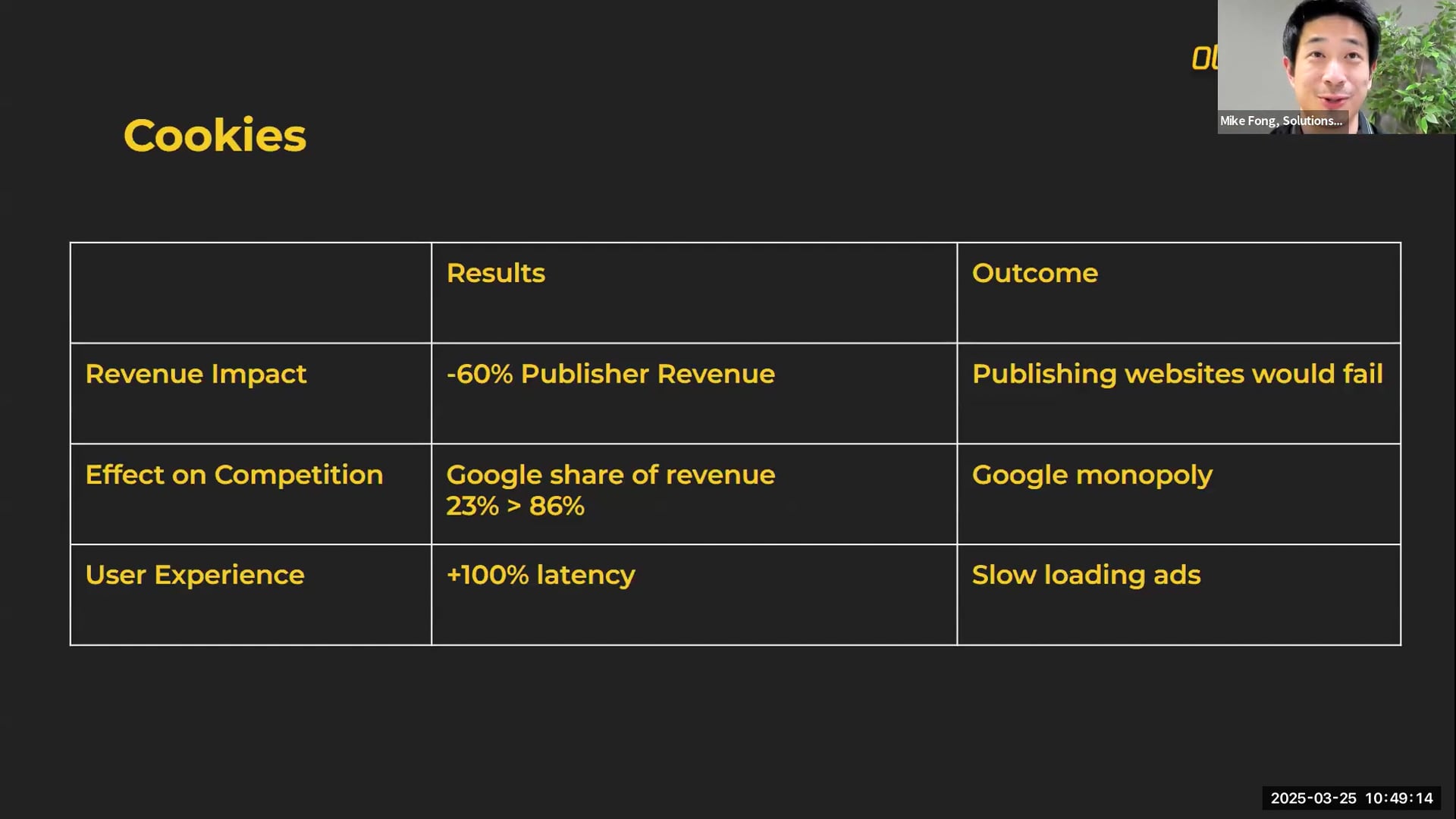
It does hurt to spend a year or two of your life researching a topic and then have Google cancel it, but here we are. Fourteen months ago, Google Chrome — representing 65% of the browser market — was on the cusp of phasing out third-party cookies. Safari, Firefox, Brave, and Edge had already done it. The plan was to roll out deprecation from a 1% test group in January 2024 to 100% by summer 2024. During that testing period, Google worked with ad tech partners and the UK's Competition and Markets Authority. The replacement system — called Topics — would have Chrome build interest profiles about you locally within the browser, which advertising vendors would read via an API to serve targeted ads. The idea was to protect privacy while keeping targeted advertising alive. But the results from testing were pretty bad. The overall revenue impact on the ad tech space was potentially a 60% drop in click-through, impression, and conversion revenue — a step change that would have caused many publishers and ad tech vendors to fail. On the competition side, Google's share of that remaining revenue would have grown from 23% to 86% of a much smaller pie — an even stronger monopoly on a smaller market. And the latency required for the new system to work caused ads to load slower, meaning many users on slower connections simply moved on before an impression was registered. On July 22nd, 2024, Google decided — with the blessing of their partners and the CMA — not to deprecate third-party cookies. They've announced a "new way forward" without much detail yet, but the deprecation isn't happening anytime soon. That's why there's now a huge demand for ongoing third-party cookie reporting — previously the attitude was "they're going away, don't bother," but now they're here to stay and organizations need visibility across their entire estate. Dave?
Cookies have always been part of ObservePoint's bread and butter. The challenge has been that answering cross-domain cookie questions — like "is this specific cookie present on any of my 15 domains?" — was possible in ObservePoint, but required a lot of clicking and patience. Next month we're launching a new reporting system that makes that question, and hundreds of others, extremely easy to answer. Where is this cookie across all my sites? When did it first appear? What are my sites with the largest number of third-party cookies? What does my entire cookie inventory look like across all domains and all audits over time — and how does today compare to six months ago? All of that becomes very easy to answer.
We've set up three scenarios to walk through. The first is a complete cross-domain cookie inventory. Imagine you own two large websites — you can now see a full inventory of every cookie across all your properties, categorized by first-party or third-party. The new reporting interface is genuinely every analyst's dream: it's like a fully flexible spreadsheet built into ObservePoint, with hundreds of metrics available as columns. You can see when a cookie first appeared, when it was last seen, what technology it's associated with, and how it's being set. One interesting thing we noticed: when Google was planning to deprecate third-party cookies, they introduced the partition key as a transition mechanism. Almost no one adopted it — because no one believed Google would actually go through with deprecation. The near-zero partition key adoption is a kind of historical artifact you can now see in the data. The second scenario is longitudinal tracking — running the same audit weekly and plotting how your unique tag and cookie counts change over time, giving you confidence that nothing major has shifted on aggregate. The third is simply a broad overview across a large number of audits and domains, giving you a high-level view across your entire estate. This launches in April — if you're a current ObservePoint customer and want early access, please reach out.
Last topic, and this one was absolutely top of mind at Adobe Summit — I'd say 75% or more of conversations there revolved around accessibility. If you operate anywhere in the EU, or if you have any EU operations at all, this is already on your radar. Mike, you're boots on the ground in London — what are you hearing?
A lot of our customers have been coming to us on this. Before we get into the regulation side, let's just think about the human aspect. The internet is about 30 years old. People who were young adults in 1995 are now starting to get elderly — and a large and growing portion of internet users are genuinely experiencing declining eyesight. Even before considering any legislation, the revenue impact of an inaccessible website is real. The European Accessibility Act comes into force on June 28th, 2025. It requires websites and apps — iOS and Android included — to meet a defined level of usability for blind and visually impaired users. Initially it applies to new or significantly changed digital properties. In a couple of years it will apply retroactively to existing sites as well. The globally accepted measurement standard is the WCAG — the Web Content Accessibility Guidelines from the W3C — and that's what compliance will be assessed against.
We've had an accessibility tab in our page details report for about seven or eight months — it shows all accessibility problems found on a single page, drills down to the HTML level, and tells you exactly what needs to be fixed. We got great feedback on it, but it falls short at scale. If your site has a thousand pages across fifteen domains, clicking through one page at a time isn't workable. So we've added accessibility issue reporting to the new reporting system launching in April, and I want to show two sample reports. The first is an aggregate overview — every row represents a unique combination of domain, WCAG criterion, impact level, and issue description, with a column showing how many unique pages are affected. I sorted by that column so the highest-impact issues are on top: the most common issue on medium.com affects 44,000 pages. Fix that one WCAG criterion and you've addressed the problem across tens of thousands of pages at once. Each criterion links directly to the WCAG documentation so your dev team knows exactly what to do. The second report is a deep-dive drill-down sorted by impact level — critical issues first — showing the specific URL, the WCAG version and conformance level, a summary of the issue type, the exact HTML element causing the problem, and the CSS selector your dev team can use to locate it in the browser dev tools. You can export either report as a CSV, copy and paste directly into a Google Sheet, or share a live link that auto-updates every time ObservePoint completes a new scan. The goal is to give leadership a progress report, give your team a prioritized bang-for-the-buck remediation list, and give your developers a precise technical brief — all from the same system.
Being able to automate the accessibility monitoring flow is going to be a game changer, especially for organizations in highly regulated industries where the litigation risk is real. If anything from today's session is relevant to your team — please reach out. Reply to the invite email, drop something in the chat, or come find us. We want to hear your questions and we want to help. Thank you all for joining today.
Thanks, everybody.
Thanks for coming!